
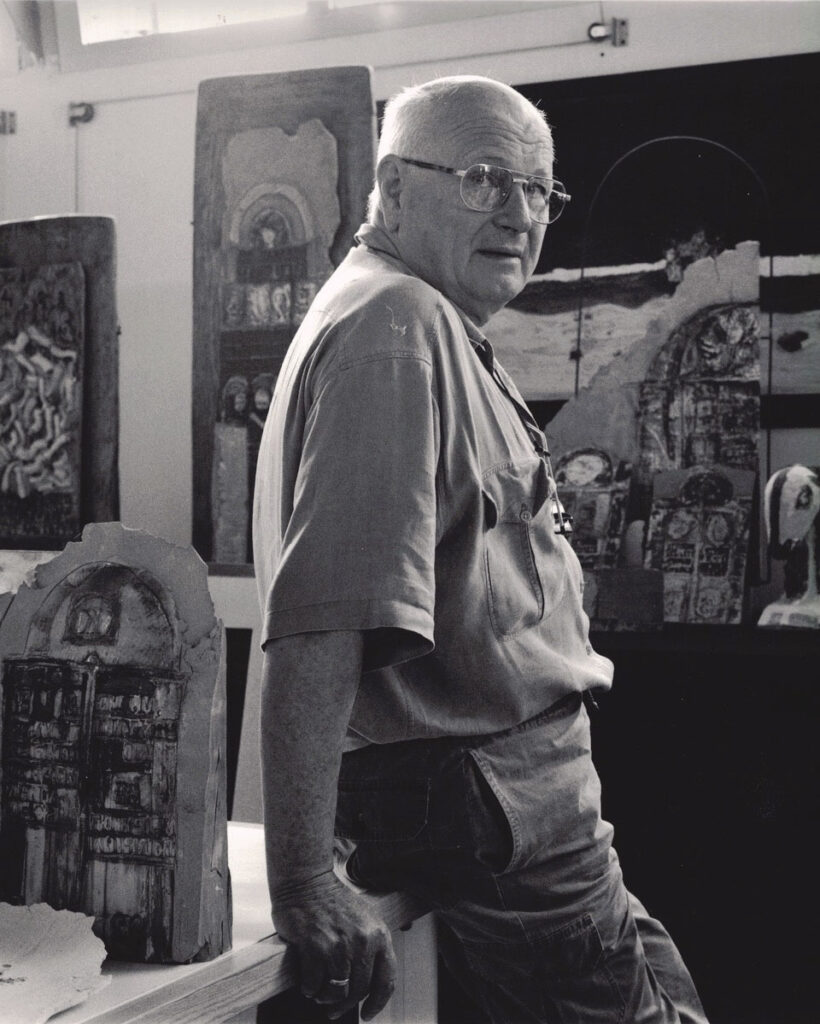
Cesare Sartori (Nove 1930 – 2020)
Cesare Sartori's story is tied to a series of artists and designers united by their use of ceramics, whose point of reference was the region of Nove (Vicenza) and its surroudings. Born in 1930 in the small town in the Upper Vicenza area, he attends the local G. De Fabris art school under the headship of Andrea Parini and Giovanni Petucco, undertaking an apprenticeship in some local businesses, including the workshop of Petucco and Zen. These years are essential to show a new generation of creatives what new developments can take place in the artistic ceramic sector, which for centuries had characterized production in the region.
His studies continued until 1954 at the Carmini art institute in Venice, in the company of his friend Federico Bonaldi, among others. During his time in Venice, he had the opportunity to meet important figures in the art sphere, such as Carlo Scarpa and Emilio Vedova, and attended, for a short period, the Academy under the instruction of Cesetti. His first important sculptures are from that period, mostly bas reliefs, sometimes perforated, which stand out for their primitive expressionism, animated by gentle strokes. He received several awards, and his works were published in magazines such as La Ceramica and Domus. The inspiration for these bas reliefs, in which stylized strokes are coupled with a limited color palette, comes from the observation of the activities and people that animated the town, as well as from stories and written works from the past, including religious ones.
Having returned to his native town, between the mid-1950's and up until 1977, he teaches design, and reveals himself as one of the active proponents of the renewal of education in the Nove art school, along with Pompeo Pianezzola and Alessio Tasca. The need, in those years, was to develop a language, in teaching, which could give the students the necessary tools to read what they were seeing.
His attention turns to the possibilities of the rising Italian design; in this sense, his coeval activity as artistic director of Società Italiana Ceramica Artistica (SICA) factory is key. The factory, led by the owners Stefano Guzzo and Angelo Perin, had, with great foresight, identified the abilities of the young Sartori as a sign of a creative mind that was able to grasp elements of the contemporary artistic currents, and translate them into proposals that could be applied to series production. His pictorial and figurative tendencies are not abandoned completely, but start to be put through a gradual process of stylization of shapes towards essential geometries. The great commission of the "Via Crucis" for the Chiesa degli Emigrati in Bern (Switzerland, 1963) is from these years.
In 1968, he starts a family workshop to produce designer ceramic objects for everyday use. In this setting, he applies the notions of Bauhaus and the Ulm School (first period). The objects are characterized by an original study of form, sometimes inspired by nature; this period is also marked by the first promotional activities coordinated through the images of Edmondo Tich, a photographer who also worked for other factories in the area. Many of the products are united by a uniform decoration, realized with colored and sometimes opaque glazes.
The workshop also becomes one of the locations of work and experimentation during the 3rd International Ceramics Symposium in Bassano del Grappa, Marostica, and Nove.
Starting in the 1980's, he reduces the volume of the workshop in order to pass to an only partially serial production; he prefers to undertake the realization of works that sometimes reached significant dimensions. The unique pieces are given names such as "craters" and "slabs," and are obtained through the combination of refractory material and thick colored glass, where oxides and pigments are made to interact.
The works are characterized by linear forms, apparently dark-colored boxes and containers that are torn open to reveal the internal polychromy. The materiality of the glass, along with the traces of engobe on the terracotta slabs, become spaces in which to evoke landscapes and arboreal elements.
Trees, in particular, become one of the artist's preferred subjects, especially for their evocative strength: the way they stand in space like human figures with extended limbs allow for them to be made to interact in groups, or as single elements inserted into metallic structures. In the meantime, he begins collaborating with his daughter Vania, with whom he initiates a fruitful, years-long dialogue and exchange, collaborating in the small-series production while maintaining peculiarities of style. The way in which the object is envisioned, not only in its functional aspects but also as a result of its surrounding space, is crucial for the approach to the material.
The "cages," sculptures inserted into geometric structures shaped by the profiles of iron cubes and boxes, are one of the most interesting results.
In the 1990's and 2000's, he opens up his works to public religious commissions, among which are the "Tomb-cenotaph for those missing in war" (1997), the Ossuary Chapel in the Nove cemetery (2006), and the Santa Maria Immacolata church in Montecchio Maggiore (2005). In this period he also creates the "fraglie," sculptures with an informal value in which the value of primal nature emerges. The profiles of mountains, realized by breaking thick plates of white clay, are references to childhood memories: the rocks where soldiers fought during the wars, but also the hidden spaces where lovers consummated their being together. In both cases, the memories are evoked through hints of writing, letters, or faces imprinted on the earth, so as to establish human presence.
In his final years, his language evolves and touches upon more general topics, picking up architectural and natural elements: his steles, the portals, but also the theaters are accompanied by the recovery of the human figure. Sartori returns to studying its form and the poses of the undisputed feminine grace, and draws on paper subtle results that he also composes in ceramic.
Selected Bibliography:
"Ceramica '80", edited by Fernando Rigon, exhibition catalogue, Palazzo Agostinelli in bassano del Grappa, May 3 - June 1 1980, s.n. 1980
"Keramikos - Ceramica di ricerca a Nove e dintorni", edited by Nico Stringa, exhibition catalogue, G. De Fabris State Art School in Nove - August 17 - 31, August 1985
Carmen Rossi, "Cesare e Vania Sartori: opere scelte", in Quaderni Breganzesi, year XI, n. 19, November 2006