
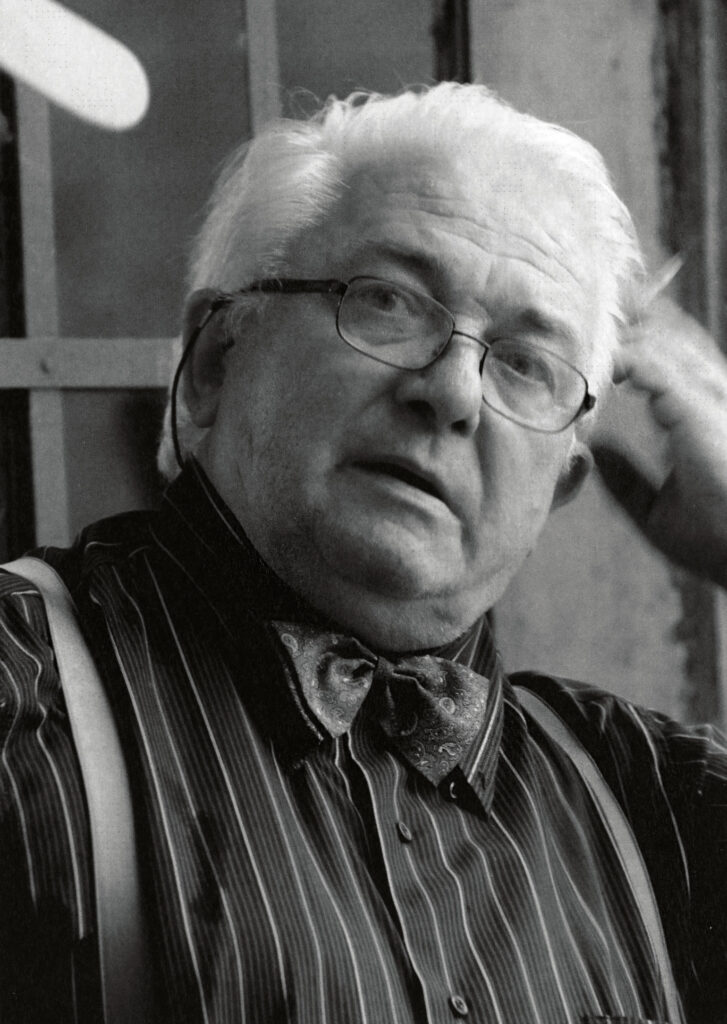
Candido Fior (San Martino di Lupari 1942 – 2021)
Candido Fior is born in 1942 in San Martino di Lupari, a town in upper Paduan region that will remain the chosen place of inspiration and creation for the artist throughout his life. He becomes an attentive storyteller of that corner of the Veneto, starting from the intimacy of small everyday things, and perfectly adherent to the stimuli of his family environment and of the landscape.
Early in his course of studies, Candido comes to know Venice and its artistic institutions, inserting himself fully in the longstanding tradition of Veneto painting, in that use of color tied to the atmospheres of a territory, in his case the countryside of the upper Paduan area, with which he maintains always an unbreakable bond. At the start of the 1960's, he comes into close contact with Nove and especially the workshop of Alessio Tasca, where he collaborates for some years making his first stylized figurines, elongated forms in terracotta decorated with engobes and etchings, of an archaic feel but expressive in their few characterizing features. He distances himself from that environment for a few formative and professional periods: some months in France in 1963, and in Verona with his friend Vittorio Fabris in 1967-68, where he teaches ceramics in an educational workshop with social purposes.
In 1970, the year in which he decides to launch his own workshop, Candido involves his entire family, in an approach tipical of Renaissance workshops. With his siblings Lucia, Sergio, and Giorgio, he adapts part of the family farmhouse, establishing workspaces next to those of daily agricultural practice. A year later, Candido marries Rita Brunati, and soon they have their first child Massimo in 1972, followed by Elena the following year, and Chiara in 1975. It is easy to perceive the quiet revolutionary potential of the simple small-series sculptures from that period. Candido Fior holds the merit of giving value to what is essential, to the rough evenness of his terracotta surfaces, barely touched by reliefs and engobes that evoke subjects or concepts of the surrounding peaceful natural landscape. An illustrative and exemplary testimony of this is the 1976 documentary "Terra Viva," by Aldebrando De Vero and commented by Enrico Crispolti, in which the open-air collective craftsmanship can be observed.
Throughout the 1970's, and more precisely between 1972 and 1979, he teaches at the art high school in Treviso. At the same time, he participates in fine craftsmanship trade fairs in Italy, and is often a guest of Stilwood stands and others abroad. He travels with friends who are original representatives of that period of innovative ferment: Carlo Bonato (plexiglass), Renata Bonfanti (textile design), Gigi Sabadin (furniture design), and Alessio Tasca (ceramics). Within that small and diverse crowd of revolutionary creatives, Candido stands out for his shy and reserved character, but also his constant dedication to creative practice as a demanding discipline in touch with reality. Although he maintains his series production, Candido continues to constantly produce drawings and paintings that amplify his vision. The perception of an environmental color that is intensified in a human presence, the precision of his lines and the maniacal care for the rendering of focused shadows make each of his paintings a microcosm unto itself. The imagination led into a constantly known and lived territory is the essential characteristic shared by his entire pictorial production, which evokes an inner Arcadia.
In the 1980's he participates in competitions and art shows in Italy and abroad, especially with the group of fellow Italian artists formed by Antonio Bernardi, Federico Bonaldi, Giuseppe Lucietti, Pompeo Pianezzola, Cesare Sartori, and Alessio Tasca. The sculptures of that period often open up a sacred dimension, but in an authentic and unique manner, where the presence of the otherworldly is evoked simply by a few revealing elements.
While his serial production began to peter out, it is remarkable how his sculptural pursuit followed a completely different direction, at the edge of ceramics, with fusions of sand and glazes, and sometimes metal inserts, which synthesize even more those bustling and vivid landscapes. Those expanses covered in frost, frozen in time, but still colored and lively, are presented as architectural findings, remains of some civilization upon which nature is instilling new life. Finally, it shouldn't be forgotten that the creative need that Candido experienced led him to an intuitive use of canons and linguistic codes characteristic of different artistic currents, while not directly subscribing to them. This is the case with his aerial sculptures, significant expressions of his pictorial feeling translated through the use of humble, waste materials, almost as if they were toys created by a child's hands.
Selected Bibliography:
Carla Caccia, “Gli incontri di «arredorama» con… Candido Fior”, in Arredorama, year VII, n. 33, July 1974
“Candido Fior – Opere silenti”, edited by Carmen Rossi, exhibition catalogue, Antonibon-Barettoni ex-mill in Nove, August 30 - October 4 2009, Edizioni Terra Ferma - Vicenza, 2009
“Candido Fior – Il respiro delle cose”, edited by Giuliano Menato, exhibition catalogue, Palazzo Pretorio, Cittadella, June 5 - July 11 1999, Edizioni Biblos - Cittadella, 1999