
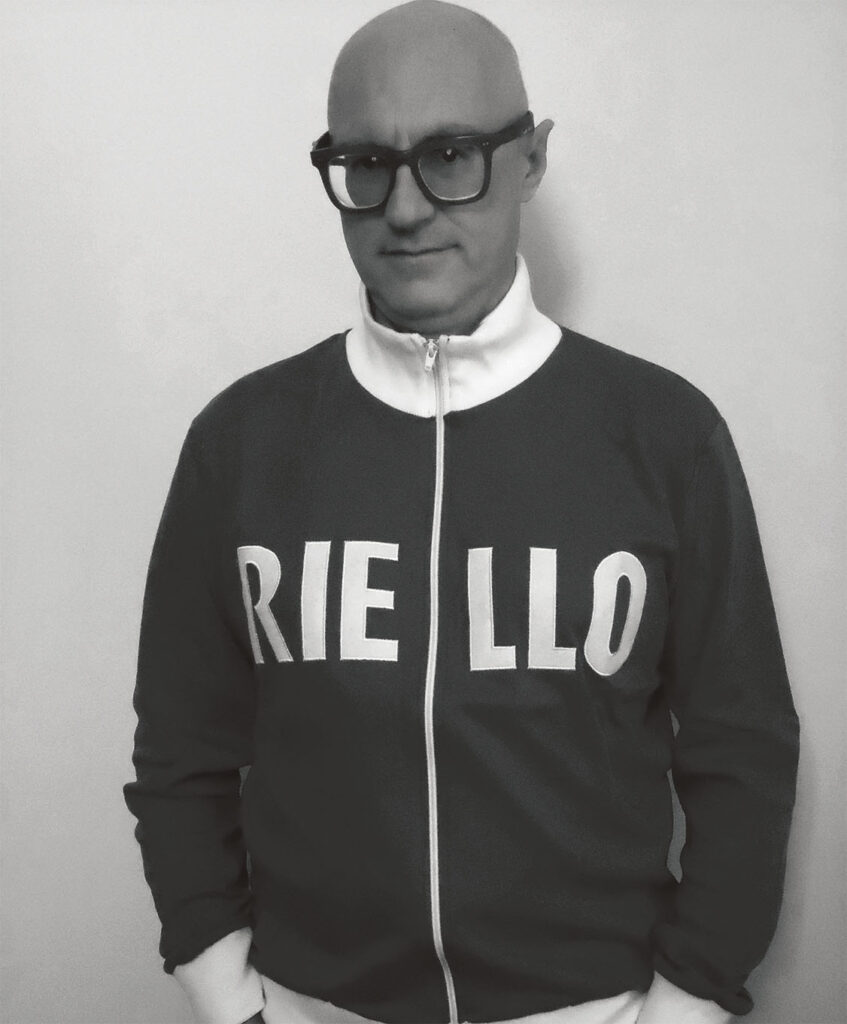
Antonio Riello (Marostica, 1958)
Hailing from Marostica (Province of Vicenza), his artistic consciousness begins in his school years: first the scientific high school in the nearby Bassano del Grappa, and then the bachelor's degree in Pharmaceutical chemistry and technology in the University of Padova, from which he graduated in 1982. In the following years, besides practicing his profession in a family context, he attends the IUAV in Venice and creates canvas paintings on the theme of urban landscapes.
In the second half of the 1980's he goes through a series of shorter and longer stays in the United States, and in 1990 he wins a scholarship from the Pollock-Krasner Foundation in New York.
In the first half of the 1990's, he begins elaborating an attention to what, at the time, was known as "Italian Ironic Conceptualism," discovering an affinity with the work of artists such as Corrado Bonomi, Alessandro Galbiati, and Francesco Garbelli. Some first examples of this phase are his "factoids" (Natural History Museum, Milan, 1992), false archaeological finds made to be exhibited and to dialogue with the collections of museums, in which love for science is united with passion for museums as guarantors of authenticity.
The preeminence of context over text and its symbolic form is typical also of contemporary art: once a work enters into recognized contexts and circuits, it is elevated to artwork.
His approach to strong themes, read with anti-rhetorical sarcasm, continues, showcasing works that touch upon uncomfortable subjects, like "Mafia Reliquien" (Halskratz Gallery, Mannheim, 1994), for which he recreates possible "mafia" family households, through tables laid out with furnishings decorated with symbols relating to violence.
Between 1996 and 1997 he goes beyond the confines of materiality by ideating, creating and publishing online an artist's videogame titled "Italiani brava gente" ("Italians, the good people"). Following on the style of its precursor, Space Invaders, the videogame consists in a schematic reconstruction of the conflict that was playing out at the time between Albanian refugees and Italian coast guards, that is of the latent xenophobia towards the Albanian people.
He transfers his creative horizon to Milan where, up until 1999, he teaches several univrrsity courses dedicated to the theme of the videogame as an artistic medium.
He continues his work of deconstructing certainties, and in 1998 begins a research on small arms, which quickly becomes the leitmotif for a series of works titled "Ladies Weapons."
The novel collection of "ladies' weapons," not by chance renamed with names of women referring to the areas of production of the exhibited models, with unusual finishings and colors (hot pink, sequins, leopard prints, golden, etc.), contrasts with the dark aspects of the contemporary social context.
Weapons as a symbol of a violence that is "apparently removed" from aesthetic practice, carried out by fashion, design, and sometimes art itself, which render such products captivating.
The newfound international scope of his work allows him to have a greater presence in London, where he begins residing continuously. His provocation on weaponry continues, and in 2003 he begins exploring weapons of war through ceramics.
The Gatti workshop in Faenza becomes the ideal partner for the reproduction of weapons with decorations typical of Renaissance Faenza: the series of"Ceramic weapons." Fascinated by the history of these decorations, whose origins can be traced to the medieval Middle East, the artist presents works that are characterized by a fragile aggressiveness, a potential oxymoron of the human being in a time of crisis. The irony with which he approaches his artistic projects grows in recognition and is ever more present in museums.
In 2005 he opens a personal show at the Mart in Rovereto titled "AirMart," a successful attempt at transforming the large architectural complex into a full-fledged airport.
By implementing specially designed signage, flight announcements, reflections of lights and other details, the artist sets off a short circuit provoked by our experiences in one of the many non-places discussed by Marc Augé.
From 2007 he undertakes collaborations with important contemporary art museums in Europe with "Be square," the design and production of uniforms for present staff. Specifically, the classic tartan is revisited time and again by inserting an error, a tribute to the imperfection that renders it an element of collective identity.
Around 2009 he begins a personal reflection around books, understood as carriers of ideas as well as physical objects that must be cared for. A keen bibliophile, in his series "Ashes to ashes" he chooses to undertake an equally destructive and redemptive action for each of the books read in his past: the operation is ongoing. With a dedicated furnace, he burns book pages and covers, collecting the ashes in special urns purposely made by Massimo Lunardon.
A common characteristic of this destruction-conservation is also the analysis of the single books for the purpose of sorting them, which is shared with scientific practice and other forms of classification.
Throughout the second decade of the new millennium, irony continues as the stylistic feature of many installations in numerous international contexts. His eclecticism, paired with an anthropologist's systematic approach, leads him to investigate marginal elements and to favor unconventional, but not necessarily uncommon, objects as places for reflection.
He creates several "impossible objects" and begins working on great doormats made out of recycled coconut fiber, upon which he arranges symbols of contemporary fears, transforming them in to art that can be walked over. The influences of weapons also return, now complex and of considerable size, with large missiles ("Honest John," an installation for "Ex Voto" in Bassano del Grappa in 2016) or fighter planes to scale, also painted with religious scenes. The paradox between a weapon of destruction and the images of saints turns into conflictual paths and bizarre tributes to Italian art history.
During the lockdown due to the pandemic in 2020, he begins an extended series of drawings called "Confined objects," in which he carries out domestic inquiries with paper and ballpoint pen.
An intimate mapping of everyday objects, with special attention given to culinary ones, acknowledging the kitchen as the vital center of the home.
Selected Bibliography:
Antonio Riello, Mafia-Reliquien, edited by Galerie Halksratz - Mannheim and TraccEdizioni, 1994
Antonio Riello, Ladies weapons, Marinotti editore, Milan, 2001
Antonio Riello, Airmart, edited by G. Verzotti, Edizioni Charta Milano, 2005
Antonio Riello, Museomania #8, edited by Chiara Casarin, Comune di Bassano del Grappa, 2018