
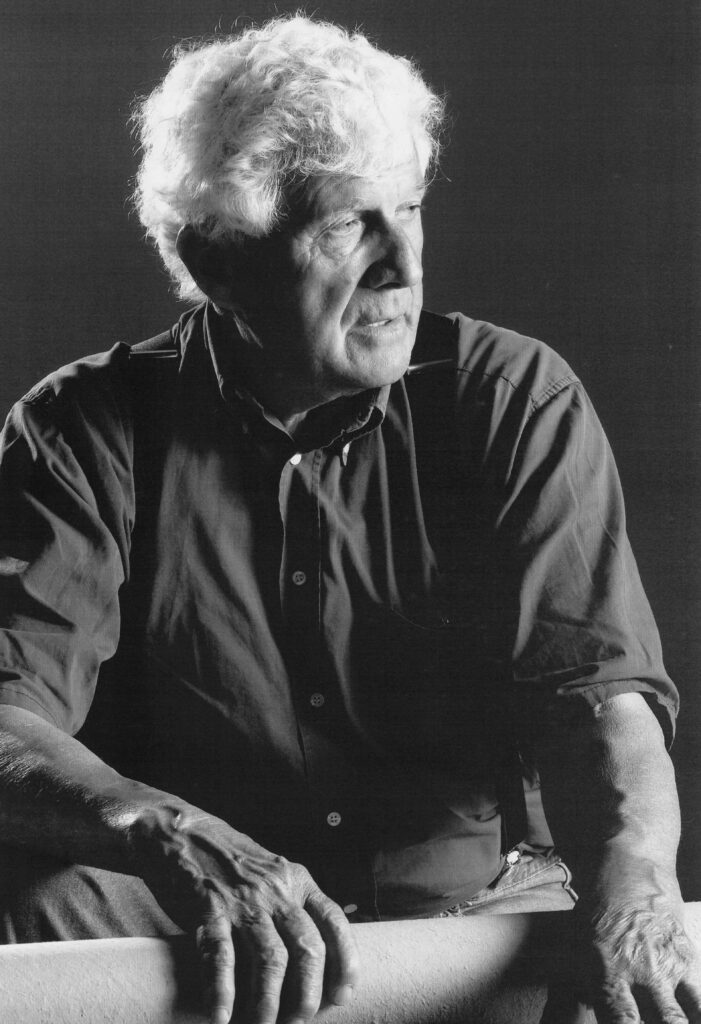
Alessio Tasca (Nove, 1929 – Heilbronn, 2020)
Born in Nove in 1929 into a family of musicians and decorators, he showed a great passion for drawing, which he developed in the studio of painter and ceramicist Giovanni Petucco. He attended the local school, annexed to the then Royal School of Art "Giuseppe De Fabris," where in 1942 the Sicilian artist Andrea Parini took over as director. This artist from Caltagirone, together with Petucco and, later, Pompeo Pianezzola, would become a driving force for pedagogical renewal and a more contemporary vision within the small institution. Encouraged by Romano Carotti, he continued his studies at the Venice Institute of Art, a place of encounter and exchange where the influence of Martini gradually gave way to the demands of the more recent Fronte Nuovo delle Arti and Spatialism. In 1948 he began teaching at the local evening school of the art institute, and that same year he founded F.lli Tasca artigiani ceramisti together with his brothers Marco and Flavio.
The early 1950s coincided with rapid growth of the family workshop. He took part in numerous exhibitions and high-end craft competitions, showing his ceramics — vessels and figurines — initially characterised by the use of variously etched majolica and, on the production side, distinctive colours such as "Morelli green." He was invited to participate in the Venice Biennale (decorative arts section) and the Milan Triennale, as well as many other public events, winning various prizes (Premio Palladio, 1958) and creating large decorative panels for religious and public buildings, exceptionally also in stone. Critics noticed his talent and his works were published in several magazines; he also began collaborating with a number of galleries.
In 1961 he left the firm to his brothers in order to set up his own workshop, where he produced sculptures in refractory materials and wheel-thrown majolicas characterised by a "lobster red" colour, which earned him several prizes (Vicenza, Gubbio). His approach to production involved coordinating many collaborators, including Candido Fior, and external contributors entrusted with the creation of special objects. Each employee's contribution was paramount — not merely as an executor, but actively invited and encouraged by Tasca himself to contribute ideas and experiments. The workshop was therefore not limited to his own production space, but extended to the town and beyond, seeking materials, tools and inspiration elsewhere.
In 1962 he resumed teaching, succeeding Giovanni Petucco in the plastic arts post at the Nove Institute of Art, where he would remain until 1978. He experimented with and recognised the potential of the extrusion press, and in 1967 began a wholly original series production that earned him recognition (Venice and Gubbio Biennali, Milan Triennale) and a permanent presence at the Victoria & Albert Museum with his Cornovaso.
In 1970 he collaborated with Carlo Bonato for Fusina, a workshop specialising in the working of methyl methacrylate, better known as Perspex or Plexiglas: this became a new testing ground for experimentation and critical acclaim (gold medal at the XV Milan Triennale). In the second half of the 1970s he continued producing small-series furnishing accessories, also thanks to exchanges with new collaborators — Nico Toniolo, Orazio Canesso, Enrico Stropparo. He began working by extrusion on large-scale sculptures, in particular the first Sfere (Spheres). The symposia organised between Bassano and Nove during those years gave him the opportunity to meet Lee Babel, with whom he opened a new chapter of his life.
From 1978 he left the workshop on Via Roberti — whose production continues to yield original results thanks to his son Vittore — and for nearly ten years devoted himself to restoring an ancient "factory of crystalline and red terracotta" located in Rivarotta, on the border between Bassano and Nove. This equally philological and artistic undertaking was presented to the public in 1989 with an address by Luigi Meneghello: from that moment he returned to large-scale sculpture, using diverse materials such as stoneware and refractory clay in various shades and engobes. With these new works Tasca clearly marked a break from his earlier serial production, in favour of sculptures that define space through the weight of raw, rough matter, even more closely tied to the "earth." This is reflected in the naming of the works, which almost phonetically echo ancient-sounding place names.
During these years he was repeatedly invited to take part in international group shows alongside other ceramic artists, recognised as a master. In 1992 he completed the public commission of the Mura Antonibon, giving form to the history of the town in large extruded panels — an ideal continuation of the work he had carried out in polychrome plaster thirty-six years earlier. Using the same technique, he produced a reinterpretation of the great cycle of the months frescoed inside Torre Aquila in Trento.
In 1997 he organised the major retrospective Terre Rare at the Basilica Palladiana in Vicenza, retracing the key highlights of his career.
In the 2000s his artistic commitment was accompanied by a desire to promote and raise awareness of local and international ceramic art. Notable examples include the conception and organisation in 2003 of the exhibition "Terrecotte cinesi – Dalla 48esima Biennale di Venezia", which involved the conservation and restoration of the extraordinary life-size sculptures created by Chinese artist Cai Guo-Qiang in 1999, as well as the posthumous retrospective "Romano Carotti. 1926–1972 Ceramiche Dipinti Disegni," dedicated to the artist and trade unionist.
In his final decade he pursued personal research projects, including a monumental transcription of Ludovico Ariosto's Orlando Furioso enriched with drawings and personal memories, and organised exhibitions together with Lee Babel in Italy and abroad.
Selected Bibliography:
Alessio Tasca. Terre rare, edited by Nico Stringa, exhibition catalogue, Basilica Palladiana, Vicenza, 29 November 1997 – 25 January 1998, Neri Pozza editore, 1997
Alessio Tasca. Dare forma alla terra, edited by Giuliano Menato, exhibition catalogue, Villa Valle, Valdagno (VI), 20 May – 1 July 2001, Grafiche Antiga, 2001
Alessio Tasca a Montelupo, exhibition catalogue, Priora di Montelupo Fiorentino (FI), 21–29 June 2008, Bozzetto edizioni, 2008