
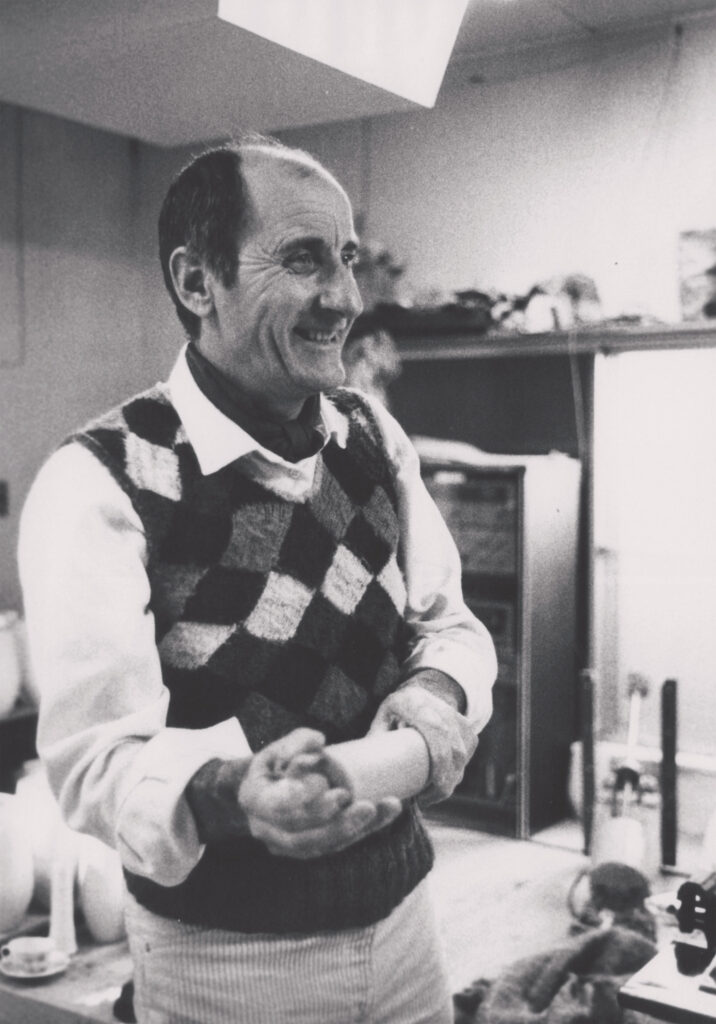
Pompeo Pianezzola (Nove 1925 – 2012)
He is born in Nove, a small town in the Upper Vicenza region, where he attends the local Royal Art School for ceramics and design, named after the fellow townsman Giuseppe De Fabris, a sculptor who was a student of Canova.
He shows an innate ability to paint, and begins working at a very young age in the historic Barettoni factory (formerly Antonibon), where he learns traditional forms and decorations alongside esteemed decorators. There, he meets artists passing through, such as Arturo Martini, Carlo Scarpa, and Ruffio Giuntini, and begins practicing oil painting as well. In 1945, right after his military service and in conjunction with his return to the factory, he is called by Giovanni Petucco to teach in the local art school, under the leadership of Andrea Parini. This pushes him to consider a teaching path, and to study at the Academy of Fine Arts in Venice. The stimuli that come from the Venetian environment lead him to take a greater interest in the graphic arts, especially etchings, and to graduate in "decoration" in 1950, under Bruno Saetti.
During the 1950's, he participates in exhibitions and painting and ceramics competitions, receiving flattering accolades, such as from Giò Ponti, who repeatedly publishes his works on the magazine Domus. Starting from a pictorial realism filtered through the example of Picasso, he initiates his series of Windows (or "railings," as defined by Parini), made out of perforated and glazed terracotta. Through a slow evolution of what were, at the time, still called decorative arts, and from an international design perspective, from 1957 to 1964 he produces in his worskhop, along with Antonio Lucietti, different series of interior design items, such as lamps, vases, and panels. He brings these items to numerous group shows in Italy as well as abroad, and initiates collaborations with several art galleries.
The production of unique or limited series works continues, defining a sober style of gentle craftsmanship, in majolica and earthenware whose decorations, which started as references to nature, turn early to a hand-drawn geometrism.
In 1962, he hands over his series production to the Zanolli & Sebellin factory, initiating a fruitful collaboration with them as a designer.
In the beginning of the 1960's, he shifts the scratched markings he used on cups, bowls and shields towards softer, repeated strokes, favoring dark backgrounds with contrasting colors in the foreground, including the use of metallic lusters. In those years, he receives many public accolades, including, in 1963 the Palladio Prize and the Faenza Prize in its first international edition. He also participates in the "arcicucco exhibition," the group show dedicated to reinvent the traditional sculptural whistles known as cuchi. From 1963 to 1968 he directs the Nove art school. In 1966, he has his first personal show at the Galleria la Chiocciola in Padova, where he presents his Alveari (beehives), whose surfaces are characterized by a geometrical modulation in a constructivist perspective. In 1968, he begins collaborating as a designer with the Appiani factory in Treviso, where he proposes new ideas for a wide range of tiles.
He begins experimenting with other materials, particularly with sprayed plexiglass sheets and silkscreened metal plates, with his series Fluttuazioni (fluctuations), which ideally approaches Op Art and Kinetic Art. The 1970's are characterized initially by the choice to use industrial materials and geometric parameters, with the intention of recovering the chromatic vibrations that are typical of Veneto painting. While on one hand it is possible to find in these works an echo of ancient, perhaps Byzantine, mosaic cultures, his serial arrangement becomes precious, and searches for a purity in the chromatic ceramic material. He continues to exhibit works in Italy and abroad, both in personal and in group shows, and often represents Italy in the field of ceramics research alongside colleagues such as Carlo Zauli, Nanni Valentini, Nino Caruso, and Salvatore Cipolla. In the mid-1970's his informal retrieval of matter is coupled with thick scriptural marks. In 1977, he completes his teaching activity, after 32 years.
The following year, he is present at "Presenze 78", an important exhibition held in Palazzo Bonaguro in Bassano del Grappa, where he stars along with Federico Bonaldi, Candido Fior, Giuseppe Lucietti, Cesare Sartori, Alessio Tasca, and Antonio Bernardi. This same group of artists will showcase their works repeatedly through the following decade.
The 1980's are, for Pianezzola, a time in which to clearly define his Pagine ("pages").
Ever since his multiple personal exhibitions held in Japan, a complexity emerges, with friezes and lines that merge in layers that overlap on the underlying material, both in monochrome and in the chromatic interplay of glazes and reactants. His work is particularly appreciated in the Far East, and is interpreted as a point of contact between cultures. The apparent sign language that can be glimpsed on his surfaces seem to refer to unknown alphabets of faraway civilizations, difficult to place, elegant and precise in their immateriality. Pure painting, even if on thin ceramic slabs, is the dominant trait of his works, which begin to show textural marks and scars, lacerations, gleams of light and drops of color. His Pagine become a space of sign happenings, sorts of fossils capable of fastening history, sometimes rolled up like ancient scrolls, but also overlapped in what will become his Libri ("books"). A long-lasting collaboration begins with some local public institutions, namely Bassano del Grappa and Nove, designing and promoting ceramics with thematic exhibitions that open up to contemporary European research: the educational exhibition "Esplorazioni - La Ceramica" (1984), "Oltre i 1000 gradi" (1985), "Ceramisti inglesi a Bassano" (1987), "Terre di Spagna" (1988), and "Terre dell'est" (1991). His contribution was crucial also in the large exhibition dedicated to the history of ceramics in Vicenza, and held in the Palladian Basilica in that same city, titled "Fictilia" (1989-1990).
In the following decade, his pages and books are characterized by a material lightness that borders on a spiritual rarefaction, and he sometimes transposes them into important installations, including as public commissions. This is the case for the complex 1992 work Alveo ("riverbed"), located in Montecchio Precalcino, which is a visual and material synthesis of local history. His recognition as a master of contemporary ceramics is certified by his participation in many national and international exhibitions (such as in Galerie Besson in Lyon and "Segni e impronte del tempo" in Faenza in 1993), but also as a judge and professor in competitions and workshops.
Semantic vibration remains the heart of his works in this decade, which are sometimes realized for international thematic exhibitions. Matter is, however, altered, and those pages or books are broken and altered according to three-dimensional volumetric decisions.
The rarefaction of color and of the mark, combined with the pursuit of lightness, reaches its peak in the personal exhibition "Bianco viaggio intorno al neoclassico" (2003), in which he reinterprets the work of Canova. The whiteness of the majolica and the use of carefully chosen papers, torn and layered inside display cases, represent a return to his early days, and, at the same time, an innocent gesture in which to practice the purity of art.
Selected Bibliography:
"Pompeo Pianezzola. Segni e impronte del tempo", edited by Lamberto Fabbri, exhibition catalogue, Circolo degli artisti in Faenza, November 30, 2002 - February 9, 2003, Quaderni del Circolo degli artisti, 2002
“Pompeo Pianezzola guarda Canova. Bianco viaggio intorno al neoclassico”, exhibition catalogue, Libreria Palazzo Roberti in Bassano del Grappa, November 22, 2003 - January 4, 2004, Tipografia Rumor, 2003
“Pompeo Pianezzola. L’anima delle forme. Ceramiche e dipinti per il XX secolo”, edited by Nico Stringa, Grafiche Antiga, 2005