
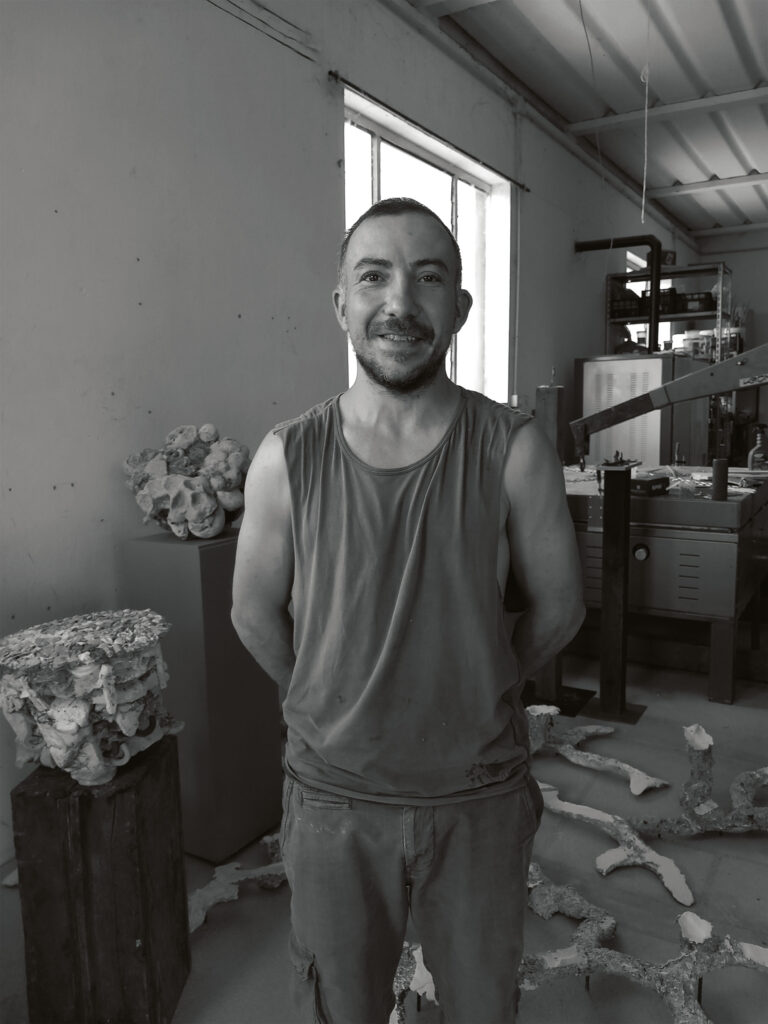
Alberto Scodro (Marostica, 1984)
Hailing from Nove (Vicenza Province), he graduates in restoration and later obtains his degree at the IUAV in Venice, where he develops a personal perspective on art. In 2008, having completed his studies, he mounts a performance installation titled "I Magi", inspired by the Adoration of the Magi by Botticelli: canvases of different sizes and decorated with different techniques, coated in acrilux and fresh porcelain, and used by the performers as drums to recount the movement and path of the Magi.
From the beginning, his approach is characterized by tension and the possibility of site specific investigations, through the temporary or permanent transformation of a place. In 2009 and 2010, he is among the recipients of a workshop for residency with the Fondazione Bevilacqua la Masa in Venice, a period in which he deepens, on a theoretical and conceptual level, his approach to architectural contexts and influences derived from reading or meeting other artists. While operating on multiple fronts, he designs and realizes a large autarchical installation titled "Fune" (Rope), in the Spazio Monotono in Vicenza. This first large design work embraces within a single vision the inner and outer exhibition spaces, creating a sort of "machine" that is activated by the natural element of rain, chanelled to transform the work of the artist, drawings meant to "flower" thanks to the vapor generated in one of the spaces. As with subsequent installations, such as "Spannung" in Viafavarini - Fabbrica del Vapore in Milano, or "A handful of Sun" in Werbank in Lana in 2013, as well as others, the artistic process consists in selecting forms of interaction that bring change to the host venue. This dynamic continues in the following years through participation in artist's residences, including abroad (Helsinki 2014, Liège 2016, Portorož 2021, etc.).
In 2014 he begins conceiving of his works through a focus on the processual aspects of the productive phase, as in "Lethe", a sort of temporal suspension evoked by a suspended cone made out of refractory materials that recalls the upper shape of an hourglass, from which sand can spill and, falling, activate a device that interacts with the environment.
The same year marked a pivotal moment: the artist's exploration of fusions between primary materials, works in which matter is compacted through the use of kilns, which accelerate and manipulate otherwise extremely long geological processes. The series, titled "Untitled Glasssand," becomes a manifestation and crystallization of time and energy, processed through the layering and vitrification of sand, glass, glazes, oxides and metals. These same materials hold historical significance, as they were used in the manufacturing of ceramics in Nove and its surroundings, starting from the materials extracted in the nearby Brenta riverbed.
The artist's residency at Fonderia Battaglia in Milano in 2016 leads to a new series of works in which the fusion of materials becomes a space to explore the interaction between minerals and metals, especially bronze. The sculptures titled"Mole" are made out of pure bronze, and shaped through the plaster casts of mole dens in the artist's yard. At the same time, the metal fusions are used with a touch of humor, as in "Spiga d'Orata," a play on words that connects a fishbone (orata is a type of fish in italian) with an ear of golden wheat (spiga: ear; dorata: golden). This is not the only case: consider the previous permanent installation "L'ago sulla punta del Lago" (The Needle on the point of the Lake) at the MAG in Riva del Garda, in 2015.
The analysis and connection with the places he visited becomes concrete in 2019's "Australian Concentrate," in which he fuses Australian desert sands with sand from the ocean. The 2020 two-person show "Senza Nuvole," alongside SIlvano Tessarollo in the Musei civici of Bassano del Grappa is an important moment of gathering around the themes being developed. "Mineral Glass" and "Spinning Top," along with the metallic fusions of the "Sunflowers", casts of purposely grown and dried sunflowers, represent declinations and a synthesis of matter that stands between glass and ceramics. A more in depth analysis of the ongoing transformation in the economic and social fabric of the artist's context is expressed in "Pozzo sanitario" (Toilet Well), created for the 2021 artist's residency in Le Nove Hotel in Nove. The piece is a well made out of spare parts of toilets, in a way that showcases the normally invisible inner parts.
Selected Bibliography:
Senza Nuvole. Alberto Scodro, Silvano Tessarollo, edited by Chiara Casarin with Elena Forin, Comune di Bassano del Grappa, 2020
L'Italia è un giardino. Di ricerche estetiche agresti, edited by Geraldine Blais, Cinquesensi - Lucca, 2021